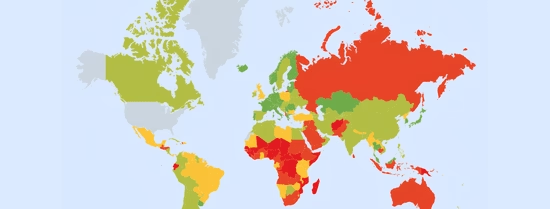
On 24 June 2026, the 14th edition of the KidsRights Index was published. The Index is the result of a longstanding collaboration between KidsRights, the International Institute of Social Studies and Erasmus School of Economics.

Global progress on kid's rights slows
The 2026 report points to a worrying global trend: progress in implementing children's rights is slowing and, in many countries, reversing. While only five countries improved their position in this year's Index, thirty-one countries moved down. The number of countries in the highest-performing group declined by 30 per cent compared with 2025, highlighting the scale of the global setback. The report also draws attention to the continued impact of armed conflict on children worldwide.
According to ISS Professor Karin Arts, co-founder of the KidsRights Index:
'Children all over the world can potentially benefit from this research. Through the years we have experienced that the KidsRights Index is a powerful tool to generate publicity and arouse curiosity among a wide range of actors, including policymakers, who can make a difference for children's rights.'
Obesity is a growing health challenge
A key development in this year's Index is the introduction of indicators on child overweight and obesity. The change reflects growing concern about what has become a global public health challenge. Today, obesity among children and adolescents aged 5 to 19 exceeds underweight worldwide. One in five children in this age group live with overweight, while one in ten live with obesity.
The report argues that childhood overweight and obesity should be understood as a children's rights issue rather than solely a matter of individual responsibility. Factors such as food marketing, the widespread availability of ultra-processed foods and persistent socioeconomic inequalities shape children's opportunities to access nutritious food and healthy living environments.
Arts explains, 'Childhood overweight and obesity combine systemic and individual features. A rights-based response therefore requires action on multiple fronts, including awareness raising, preventive measures, regulation of unhealthy food marketing aimed at children, investment in healthier living environments and targeted support for children living with obesity and their caregivers.
For media and other inquiries, you may contact Professor Karin Arts at arts@iss.nl

- Professor
- More information
What is the KidsRights Index?
The KidsRights Index is an initiative of the KidsRights Foundation, in cooperation with the International Institute of Social Studies and Erasmus School of Economics of Erasmus University Rotterdam. Academic lead is ISS Professor of International Law and Development Karin Arts. ISS PhD researcher Ekaterina Evdokimova has been involved in gathering and analyzing data for Domain 5 (enabling environment for children’s rights) of the Index.
It is the annual global index which systematically ranks how countries adhere to and are equipped to improve children’s rights. It comprises a ranking for all states that have ratified the UN Convention on the Rights of the Child and for which sufficient data is available, in 2024 a total of 184 countries.
- Related content
