Key facts
Full title: State Welfare Alternatives and Navigation Strategies
Acronym: SWANS
Project lead: Dr Gerard McCarthy
Project partners: Grace Agenda (Kenya), Labour Rights Foundation (Thailand)
Geographic regions: Thailand, India, Kenya, Uganda, South Sudan, Ukraine
Project period: 2024 - 2029
Funding: ERC Starter grant
ISS Academic Team: Governance, Policy Action, Evaluation and Entrepreneurship
Key words: Alternative welfare; Non-state actors; Gender, labour and welfare
How do marginalized communities navigate state and non-state actors to access welfare, protection and social services in contexts of state absence, crises or reconfiguration?
How are new forms of welfare provision reshaping governance, authority and social order across the Global South?
What roles do gender, labour, technology, humanitarian actors and private-sector partnerships play in transforming welfare systems and everyday survival strategies?

Researching how people access welfare, care and social protection
The State Welfare Alternatives and Navigation Strategies (SWANS) project is a six-year interdisciplinary research initiative that investigates how people access welfare, care and social protection in contexts where states are absent, fragmented or undergoing significant transformation.
Rather than viewing welfare as solely a state responsibility, the project examines how communities, civil society organizations, humanitarian agencies, private companies and public institutions collectively shape alternative systems of social provision across the Global South.
Through comparative analysis, the project seeks to advance new theoretical and empirical understandings of changing welfare governance and the everyday strategies marginalized populations use to secure wellbeing.
Case studies
The project consists of four interconnected case studies in Thailand, India, Kenya, Uganda, South Sudan and Ukraine.
These studies explore:
- platform economy and migrant livelihoods,
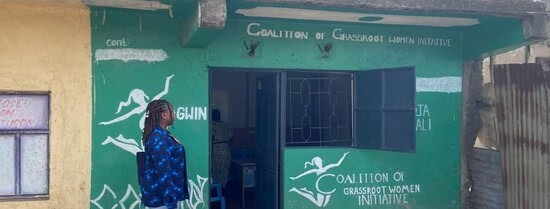
- women’s negotiations for access to social services and security in informal settlements,
- transformations in state welfare and social protection under neoliberalism,
- partnerships between humanitarian organizations and private-sector actors.
Using qualitative, quantitative and comparative research methods, including interviews, focus groups, longitudinal fieldwork and policy analysis, the project investigates how welfare is co-produced by state and non-state actors and how these arrangements reshape governance, authority and social order.
Designing more inclusive, just and equitable welfare systems
State Welfare Alternatives and Navigation Strategies Outputs
The project outputs will include academic publications, policy briefs, workshops, podcasts and public events designed to inform scholarship and policymaking on welfare, governance and social justice in the Global South.
Why is this project relevant?
State Welfare Alternatives and Navigation Strategies is relevant because it provides evidence on how more inclusive, just and equitable welfare systems can be designed in contexts where states alone cannot meet people's social protection needs.

Aims and long-term impacts of SWANS
The project aims to understand how marginalized communities across the Global South navigate changing systems of welfare and social protection, and how state, non-state, and private actors collectively reshape welfare governance in contexts of state transformation and fragility.
In the long-term, the State Welfare Alternatives and Navigation Strategies project will:
- Build interdisciplinary and comparative research capacity to understand how state, and non-state actors collectively shape welfare, social protection and governance across the Global South.
- Foster long-term partnerships among researchers, civil society and policymakers through collaborative fieldwork, comparative case studies, workshops and co-produced outputs that centre perspectives from the Global South.
- Produce evidence to inform more inclusive welfare and governance policies by examining how marginalized communities navigate alternative welfare systems, while disseminating findings through academic publications, policy briefs, public engagement and stakeholder events.
Background
Across the Global South, governments are increasingly sharing or transferring responsibility for welfare and social protection to communities, humanitarian organizations, private companies and civil society. While these changes have transformed how people access healthcare, education, livelihoods and security, there is limited understanding of how marginalized communities navigate these complex systems or how these arrangements reshape governance and social order.
The SWANS project responds to this gap by examining the evolving relationship between state and non-state actors in the provision of welfare and care.
The project centres on three key concepts.
- State welfare alternatives refer to forms of welfare and social protection delivered by actors other than the state, including community organizations, humanitarian agencies, businesses and informal networks.
- Navigation strategies describe the everyday ways individuals and households access, negotiate and combine these different sources of support.
- Finally, social provisioning refers to the broad range of processes through which societies meet people's basic needs, extending beyond formal government programmes to include diverse public, private and community-based arrangements.
By comparing experiences across multiple countries, the project aims to generate new knowledge on inclusive, just and context-sensitive approaches to welfare in the twenty-first century.
State Welfare Alternatives and Navigation Strategies research team
The project is led by Dr Gerard McCarthy and brings together Dr Sreerekha Mullassery Sathiamma, Dr Bilge Sahin and Dr Rodrigo Mena as case leads.
It also collaborates with researchers, universities, civil society organizations, policymakers and local partners across all research sites to ensure locally grounded and comparative knowledge production.
