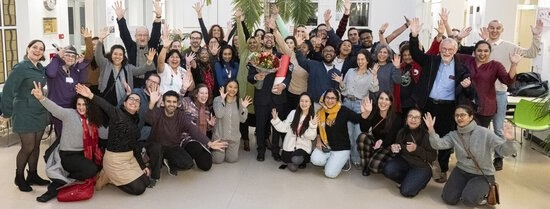
The ISS – Erasmus University Rotterdam PhD programme in Development Studies is the largest and most dynamic one in the world.
It excels in producing critical research that questions mainstream approaches and dogmas. Our graduates go on to work in both leading universities around the world and in high-level governmental as well as non-governmental positions.
Development Studies at ISS is defined broadly, incorporating inter- and trans-disciplinary perspectives from across the social sciences. PhD researchers interact with and build on various traditions and approaches, including:
- political economy
- (heterodox) development economics
- (feminist) political ecology
- post-development
- degrowth
- decoloniality
Given the institute’s long-standing commitment to transformative scholarship, our researchers pay close attention to differences and inequalities along the lines of (among others) class, race, ethnicity, indigeneity, sexuality, age and gender.
Celebrating 300 ISS PhD graduates
Highlighting the achievements of our 300 PhD graduates 1986-2026

Your PhD in Development Studies at ISS
Click on the tabs below for everything you need to know about our admission requirements, what steps you need to take to start and what the ISS PhD programme entails.
The PhD programme takes four years if pursued full-time and six years part-time.
Recognizing the difficulty of securing full funding for doctoral research, ISS makes it possible to undertake the PhD on a non-resident basis. Some of our students pursue their research while remaining resident in their home countries and, where possible, combine their study with their ongoing employment.
Minimum residency requirements at ISS during the four years is six months. Physical presence is expected at key moments during the programme, e.g. during the mandatory Dissertation Design Seminar that takes place at the end of the first year.
Fast-track PhD programme
In exceptional cases, applicants with extensive professional experience and a track-record of applied research and publications can be considered for a fast-track PhD. For further information, contact the PhD Programme Director.
Joint and co-tutelle PhDs
ISS has a number of active collaborations with universities around the world for joint/double degree PhDs.
- Master’s degree in social sciences (academic not professional education)
- Strong research proposal (ideally supported by an ISS researcher)
- Evidence of English language proficiency (IELTS 7.0)
(Applicants from the following countries are exempt from the language proficiency requirement: Australia, Botswana, Canada, Cameroon (English-speaking region), Eritrea, Ethiopia, Gambia, Ghana, India, Ireland, Kenya, Liberia, Malawi, Namibia, New Zealand, Nigeria, Philippines, Rwanda (English-speaking region), South Africa, Tanzania, Uganda, UK, USA, Zambia and Zimbabwe)
Tuition fees for four years: €32,000.
ISS has a generous tuition-waiver programme for qualified students.
PhD researchers resident in the Netherlands require €17,000/year to be able to secure a residence permit. See ‘PhD programme structure’ above for more on residency requirements.
You are strongly recommended to contact a potential supervisor to discuss your research interests prior to submitting an application.
Applications can be submitted via the Admissions Portal.
The following documents are required:
- Copy of Academic Degree(s)/ Diploma(s) MA degree*
- Certified Copy of Academic Transcript(s) MA degree *
- Research proposal (starting with a short motivation), for more information see our academic requirements page
- Master thesis (if available)
- C.V./resume
- Three references. One of these references must be an academic from your Masters programme. Referees should send their references directly to the ISS (admission@iss.nl).
- Statement of Proficiency in English (if applicable).
*If the language of these documents is not English, you must attach a certified translation to English ogether with the original transcript.
The ISS PhD programme takes four years to complete (six years part-time).
Since our students already come with a strong post-graduate degree, they take a limited set of courses during the early years of the PhD to refresh and complement their existing knowledge and skills. Some of these courses are required by Erasmus University Rotterdam (e.g. Scientific Integrity). Others are identified by PhD supervisors in consultation with PhD researchers. In some cases waivers can also be requested.
ISS is a member of CERES and coordinates its flagship training programme.
PhD researchers also have access to post-graduate courses taught at the ISS and at the Erasmus School for Social Sciences and Humanities.

PhD Study Association
The ISS PhD Study Association (IPSA) represents the needs and interests of the PhD community both formally (in various committees) and informally.
ISS also has a dedicated professional staff member who provides confidential advice and support to PhD researchers on all aspects of their academic and non-academic life.

Housing and socializing
PhD researchers resident in the Netherlands have access to ISS housing. Many researchers also rent (shared) housing in the private market.
The Hague is a cosmopolitan city with a rich cultural life. Its proximity to prominent cities both in the Netherlands and rest of Europe provides PhD students with a virtually limitless list of academic and social activities to follow.

Research topics
Our 150+ doctoral researchers work on a vast range of topics. Many concentrate their research on Latin America, Africa, Asia and the Middle East.
However, as the meaning and practice of development is evolving, ISS PhD researchers are also transcending the boundaries between ‘Global North’ and ‘Global South’ to focus their analytical lens on ‘developed countries’ themselves.
Research topics
Current ISS research is organized into these Academic Teams. As a PhD researchers you will embedded in one or more of these Teams and thus be part of ISS' Global Development and Social Justice Research programme.
- Migration, Im/mobility and Place
- Agrifood, Water and Technologies
- Gender, Sexuality and Social Justice
- Governance, Policy Action, Evaluation and Entrepreneurship
- Global Health and Economic Development
- Extractive Industries and Just Transitions
- Climate Change and Environmental Justice
- Crisis, Politics and Law