- How do contemporary extractive industries reproduce socio-ecological inequalities while generating spaces of resistance, and what transformative alternatives emerge?
- What are the dynamics of 'extractive dispossession regimes' in fossil fuels, critical minerals for the green transition, and large-scale land/resource grabs?
- How effective are transparency initiatives, policy experiments, and community resistances (e.g., EITI, keep-it-in-the-ground movements) in fostering just transitions?
Keywords: Global development; Agrarian studies; Global climate change; Reduced social inequality
The Extractive Industries and Just Transition Academic Team investigates how mining, oil and gas extraction, and large-scale resource projects shape global development.
The Team explores their effects on local communities, environments and economies – especially in the Global South – while highlighting paths toward more equitable and sustainable alternatives.

The Team's interdisciplinary approach combines political ecology, agrarian studies, development economics and fieldwork to understand issues such as:
- 'resource curse'
- land dispossession, environmental damage
- resistance movements by Indigenous peoples and peasants.
They pay special attention to the green transition, including critical minerals (lithium, cobalt) and 'green hydrogen', alongside climate-extraction links.
Examining the impacts of extractive industries on on development, equity and sustainability

Team members work across Latin America, Africa, Southeast Asia and beyond, using mixed methods from ethnography and geospatial analysis to econometrics. They engage with policy at local, national, and global levels, including the Extractive Industries Transparency Initiative (EITI).
This work contributes to Global Development, Agrarian Studies, Global Climate Change and efforts to reduce Social Inequality. Partnerships include networks focused on environmental justice, land rights and just transitions.
Extractive Industries and Just Transitions research projects


Extractive Industries and Just Transitions researchers
 Dr Ellisaios Papyrakis
Associate Professor in Development Economics
Development economics; Macroeconomics; Resource curse and institutional analysis Dr Helena Pérez Niño
Assistant Professor in Development Studies
Political economy of development; Agrarian change; Labour and extractive sectors Professor Jun Borras
Professor of Agrarian Studies
Agrarian studies; Land and commodity rushes; Peasant politics and global land governance Professor Lorenzo Pellegrini
Professor of Economics of Environment and Development
Economics of environment and development; Extractive industries; Resource curse; Fossil fuels and climate policy Professor Murat Arsel
Professor of Political Economy of Sustainable Development
Political economy of sustainable development; Political ecology; Turkey and Global South resource politics Professor Shuaib Lwasa
Professor of Urban Resilience and Global Development
Urban resilience; Climate change adaptation; Urban land use and sustainability in African cities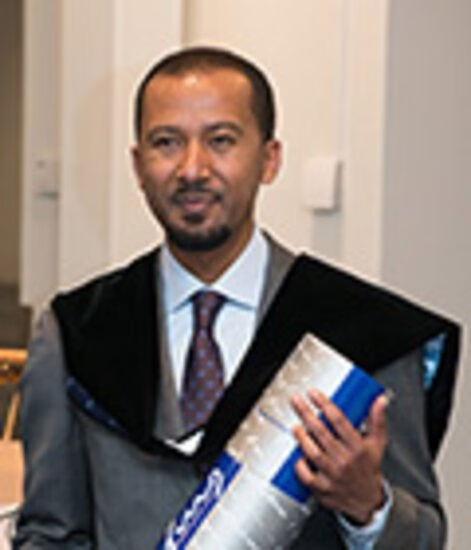 Dr Tsegaye Moreda Shegro
Assistant Professor of Agrarian and Rural Studies
Agrarian and rural studies; Political economy of land and livelihoods; Resource politics
Postdocs and visiting scholars
 Dr Amod Shah
Postdoc
 Dr Corinne Lamain
Postdoc
 Dr Lilian Sol Cueva
Postdoc
Energy futures; Gender and feminist approaches to sustainability; Public policy and climate (Mexico focus) Dr Lorenza Arango
Postdoc
 Dr Salena Fay Tramel
Postdoc
Extractive Industries and Just Transitions PhD researchers
Get in touch!

Professor Lorenzo Pellegrini
Extractive Industries and Just Transitions Team leader
- Email address
- pellegrini@iss.nl